
Divorce Doesn't Have to Destroy Your Family
Collaborative Divorce Coaching

You're facing one of the hardest decisions of your lives — and you're terrified of what it will cost: your kids' sense of stability, your finances, your ability to co-parent. There's a better way forward.
Collaborative divorce mediation helps couples in Seattle navigate separation without courtrooms, without combat, and without losing control of the decisions that matter most. We help you move from one home to two — with clarity, dignity, and your children's wellbeing at the center.
Does This Sound Like You?
✓ You don't want to fight in court — but you don't know how to agree on your own.
✓ You're worried about what this will do to your kids.
✓ You've heard divorce is expensive, exhausting, and takes years.
✓ You feel like once lawyers get involved, you lose all control.
✓ You want to stay out of each other's lives — but you'll be co-parenting for the next 18 years.
If any of this resonates, collaborative law was designed for exactly where you are.

What is Collaborative Law Mediation?
Collaborative law is a structured, voluntary process that lets both spouses resolve their divorce outside of court — with professional support, not a judge making decisions for your family.
Instead of two attorneys fighting against each other, you work together with a coordinated team: your own collaboratively trained attorney, a neutral financial professional, and a divorce coach. Everyone at the table is working toward the same goal — an agreement that actually works for your family long-term.
No courtrooms. No public record. No judge deciding your future.
Collaborative Law Divorce Might Be a Good Fit If:

You and your spouse are willing to communicate, even if it's hard right now
You want to protect your children from the fallout of a high-conflict divorce
You want to stay in control of major decisions — finances, parenting, your future
You value privacy and want to keep your family matters out of public court records
You're committed to honesty and transparency in the process
You want professional guidance without the adversarial court process
You're open to creative solutions rather than rigid legal outcomes
Not sure yet? That's okay. Our initial divorce consultation is designed to help you figure out if this is the right path — before you commit to anything.

What Does a Divorce Coach Actually Do — And Why Do You Need One?
A divorce coach is not a therapist. We don't process your grief or work through the history of your relationship. Our role is focused, practical, and forward-moving.
As your neutral divorce coach, I help both of you stay in the room — even when emotions run high — and keep conversations productive so you can reach real agreements faster.
Here's what that looks like in practice:
I manage the emotional dynamics so that fear, hurt, or anger don't derail your sessions and cost you more time and money.
I teach communication tools so you and your co-parent can have hard conversations — in sessions and at home — without it escalating.
I keep you focused on what matters — the well-being of your children and your long-term co-parenting stability — not the pain of the past.
I help you build a parenting plan that actually works — not just one that looks good on paper, but one that accounts for your children's ages, developmental needs, school schedules, and how your two homes will function day to day.
Drawing on my background as a Licensed Marriage and Family Therapist (LMFT), I bring clinical insight into child development and family systems to every parenting plan conversation — so your kids are truly at the center of the process.
Collaborative Law Divorce Coach Fees
Rate: $300 per hour
First hour of consultation is discounted to $100
Sliding Scale / Insurance not available for mediation services
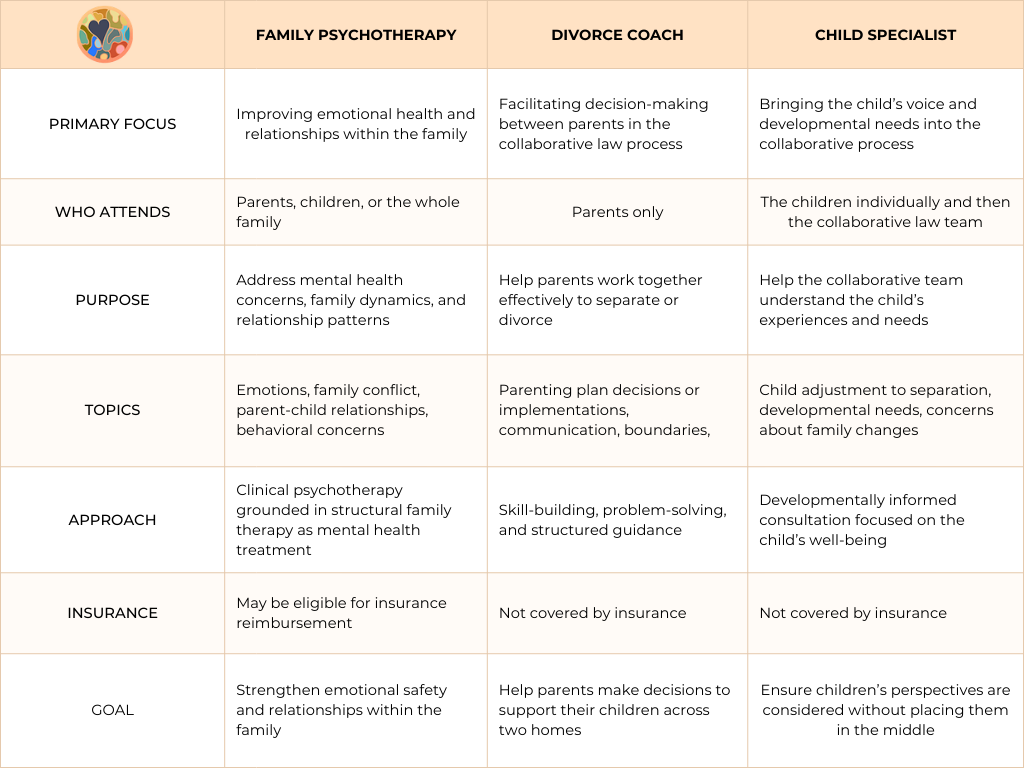
What is the difference between psychotherapy, divorce coach, and child specialist?
What’s Included in Hiring a Divorce Coach?
Collaborative Law Professional Team Member
In the collaborative process, the divorce coach is a neutral professional who helps address the emotional and communication challenges that often arise during divorce. The coach helps both spouses stay focused on productive problem-solving and supports respectful dialogue so that difficult conversations can move forward constructively.
A divorce coach helps by:
• Keeping discussions structured, focused, and productive
• Teaching communication and conflict management skills
• Supporting both spouses in navigating the emotional aspects of separation
• Helping parents develop a thoughtful, child-centered parenting plan when children are involved
Drawing on my background as a family therapist, I help parents create parenting plans that support their children’s developmental needs while also strengthening the foundation for a cooperative co-parenting relationship across two homes.
Parenting Plan Discussions
When parents separate, children need stability, predictability, and strong relationships with both parents. A parenting plan is the roadmap for how that happens. But a parenting plan isn't just a legal document — it's a co-parenting agreement that will shape your children's day-to-day lives for years to come.
I help parents think through:
Residential schedules that fit your children's ages, school routines, and activities
Decision-making frameworks for education, healthcare, technology use and major life choices
Communication norms between homes so transitions are smoother
Developmental considerations — what a 4-year-old needs looks very different from what a 14-year-old needs
Flexibility protocols for holidays, travel, and life changes
The goal isn't just a plan you can live with today — it's one that grows with your family.
Our Client Screening Form Can Help Explore if Divorce Mediation is Right for Your Family
The Collaborative Divorce Process

01 Get Going
In this mutual step, you and your spouse decide if collaborative law is a good fit for your situation. A 1 hour paid consultation with both parties is a good way to assess if collaborative law is a good fit for your situation.
Not ready to pay? No problem. Fill out our discovery questionnaire to get started. Our expert will begin assessing if this is a right fit for your family.

03 Finding Solutions
You’ll meet with your team to talk through your goals and concerns. Your divorce mediator/coach helps keep these meetings productive by managing emotions and helping everyone move towards solutions.

04 Make it Official
Once you reach an agreement, we utilize lawyers to put your agreements into a final signed writing that becomes a binding legal document.
Spouses get started by signing a Participation Agreement, promising to stay out of court and work with your professional team in a spirit of cooperation, rather than continue to bang your head against the same walls. Everyone agrees to be totally open and honest. You’ll share all the necessary financial and personal information freely, without the need for stressful legal "discovery" or court orders.

02 Sharing Information
Why I Do This Work

After years of working with couples in the midst of divorce as a family therapist, one thing became clear: most people weren't struggling because they couldn't make decisions — they were struggling because they had no structure for having the conversations.
Without support, those conversations become longer, more expensive, and more damaging to the co-parenting relationship that has to last long after the divorce is final.
That's what drew me to collaborative mediation. It gives families a real alternative — a process that produces agreements that hold, because both people actually had a voice in making them.
I'm especially committed to working with families with children, because the decisions you make now — how you communicate, how you structure your children's time, how you show up as co-parents — will shape your children's experience of this transition for years to come.
-Alexandria Scalone, LMFT Seattle Family Therapy PLLC
Ready to Explore a Better Path?
Fill out our client screening form to see if collaborative divorce mediation is a good fit for your family. We'll review your responses and reach out to schedule a conversation.

Frequently Asked Questions
-
Collaborative divorce is a process where both spouses work with a team of professionals — including lawyers, a divorce coach, financial experts, and child specialists — to reach agreements without going to court. Unlike traditional litigation, where a judge makes decisions for your family, collaborative divorce puts you in control. All decisions are made by you and your spouse, with support from your team. The goal is a win/win outcome that minimizes conflict and protects everyone involved, especially children.
-
I offer an introductory consultation at a discounted rate of $100 for a full hour — a $250 value. This dedicated time ensures you get meaningful, focused support from the start: expert guidance, thoughtful answers to all your questions, and a real sense of whether collaborative divorce coaching is the right fit for your family. It's an investment in clarity — and in the next chapter of your life.
-
A divorce coach is a family systems expert who serves as a neutral support person throughout the collaborative process. Your coach helps you identify your needs and priorities, manage the emotions that come with divorce, communicate more effectively with your spouse, and make sound decisions for your family. They work alongside your attorney — while your lawyer handles legal strategy, your coach focuses on helping you navigate the emotional and practical challenges of separation.
-
A collaborative divorce team typically includes: attorneys for each spouse who provide legal guidance; a divorce coach (mental health professional) who supports communication and emotional well-being; a child specialist who ensures children's needs are represented; and a financial expert who helps analyze assets and long-term financial planning. The team is assembled based on the family's specific needs. All professionals share information openly and work toward a unified resolution.
-
Protecting children from conflict is a core principle of collaborative divorce. Your divorce coach can help you and your co-parent learn how to talk to your children about divorce, understand how children experience family transitions, and build transitions and routines that minimize stress. Research consistently shows that it's not divorce itself, but the level of conflict children witness, that has the greatest impact on their long-term well-being.
-
A parenting plan is a detailed agreement that outlines how you and your co-parent will raise your children after separation — covering schedules, decision-making, holidays, communication, and more. A divorce coach acts as your facilitator and guide to create a plan that is child-centered, developmentally appropriate, and realistic for your family's life. Unlike a standard attorney-drafted plan, a coach-assisted plan considers the nuances of your specific family. Once your plan is complete, it can be forwarded to your attorney for filing.
-
Yes. All parties — clients and professionals — agree at the outset that communications made during the collaborative process remain confidential and cannot be used as evidence if the case later moves to litigation. This creates a safe space for honest, open dialogue and problem-solving. If the collaborative process does not result in a full settlement, the collaborative attorneys must withdraw, and new attorneys are needed for litigation. This structure gives everyone a strong incentive to work toward agreement.
-
One of the most valuable roles a divorce coach plays is improving communication between separating spouses — particularly when emotions run high. Your coach can help you shift from reactive to thoughtful communication, identify underlying interests behind positions, and develop the skills needed to co-parent effectively long after the divorce is finalized. The goal is not just to get through the divorce, but to set up a functional co-parenting relationship that benefits your children for years to come.
-
Yes. LGBTQ+ families have unique needs shaped by the legal, social, and emotional complexities that queer individuals and couples continue to navigate. Coaching is available for parents, spouses, children and co-parents who identify as part of the LGBTQIA+ community in a space that affirms and understands your experience. Your family's story is unique, and your support should be too.
-
Collaborative divorce works best when both spouses are willing to participate in good faith, communicate honestly, and commit to reaching a negotiated settlement. It's especially well-suited for couples with children, significant shared assets, or a desire to preserve a working relationship after divorce. It may not be appropriate in situations involving domestic violence, severe power imbalances, or when one party is unwilling to engage in the process. A consultation with a collaborative coach or attorney can help determine whether it's the right fit for your situation.
-
Collaborative divorce is not guaranteed to cost less — it is still a significant investment, and costs vary depending on the complexity of your situation and the professionals involved. What's different is that you and your partner are in control of the cost. You set the pace, you make the decisions, and you avoid the unpredictable expense of court-driven timelines and adversarial legal battles.
But the real question isn't just what you spend — it's what you get. Collaborative divorce tends to produce more durable agreements, meaning you're far less likely to return to court down the road. That alone can represent significant long-term savings. It also includes co-parenting coaching and family support that litigation simply doesn't offer. When you factor in the quality of the outcome — a workable agreement, a functional co-parenting relationship, and a family supported through the transition — the value of collaborative divorce extends well beyond the price tag. -
I offer collaborative divorce coaching both in-person and virtually, serving clients throughout King County. Virtual sessions make it easy to access support from the comfort of your home. I offer in-person appointments at my office located in the South Lake Union neighborhood of Seattle, WA. Whether you prefer to meet in person or online, the quality of support remains the same.
-
This is one of the most common concerns people have — and it's a fair one. You can't force your spouse to choose collaborative divorce, but you can plant the seed thoughtfully. Often, sharing information about what the process looks like, what it costs, and what it protects — especially for your children — opens the door. Many spouses who are initially resistant come around when they understand they will have their own attorney and full voice in the process. A consultation with a collaborative coach or attorney can help you think through how to have that conversation and whether collaborative divorce is a realistic option for your situation.
-
Yes — a divorce coach and an attorney serve very different roles, and both are important. Your attorney provides legal counsel, protects your rights, and ensures any agreements comply with the law. Your divorce coach helps you communicate effectively, and guides you through the practical and relational challenges of separation. Think of it this way: your attorney handles the legal process, while your coach helps you show up to that process prepared, grounded, and clear on what matters most to you and your family.
-
Maintaining stability in your children's daily life is a priority throughout the collaborative process. One of the first things your team will work on is establishing interim arrangements — temporary schedules and routines that keep your children's lives as consistent as possible while the larger agreement is being crafted. As your coach, I help you and your co-parent think through transitions, communication, and day-to-day logistics so your children feel secure even as your family structure changes. The goal is to minimize disruption and give your children a stable foundation from day one.
-
There is no single answer — timelines vary widely depending on the complexity of your situation, how many issues need to be resolved, and how prepared both parties are to engage in the process. Some families reach a full agreement in a few months; others take longer, particularly when finances, property, or parenting arrangements require more careful planning. What collaborative divorce does offer is flexibility — you set the pace, not the court. Unlike litigation, you are not at the mercy of crowded court dockets or procedural delays.
-
Both collaborative divorce and mediation are alternatives to litigation, but they work differently. Mediation involves a neutral third party who helps both spouses negotiate — attorneys play a limited role, and you may not have professional support beyond the mediator. Collaborative divorce is more comprehensive: each spouse has their own attorney, and the full team — coach, child specialist, financial expert — works together to address the legal, emotional, and practical dimensions of your separation. Collaborative divorce tends to be more thorough and better suited for families with children or complex finances, while mediation can work well for simpler situations.